Lineage: A Case Study into the largest tech-enabled rollup
It’s not a rollup. It’s just SaaS in disguise.

NOTE: this is a working piece with more to come in the following weeks, if you have any questions, suggestions, or would like to talk about the asset class, please reach out at jsmistry@uwaterloo.ca or to my LinkedIn.
AI Rollups: A New Frontier in Private Capital
From Arbitrage to Intelligence
Private equity’s next edge won’t be found on a balance sheet; it’ll be found in a data lake. For years, rollups thrived on a simple promise: buy fragmented businesses, cut costs, and sell for a higher multiple. The strategy is a math problem disguised as strategy, which, in the era of cheap capital and pre-AI returns, worked. This traditional strategy has reached its end. As macroeconomic indicators shift and exit timelines stretch, traditional EBITDA expansion and the old levers of value creation are no longer enough.
Why Now?
The timing couldn’t be better. After a decade of riding the wave of low interest rates, private equity is under pressure. Exit windows have narrowed, distributions are at record lows, and LPs aren’t buying the magic of “adjusted EBITDA” as a personality trait anymore. At the same time, portfolio holding times are stretching past seven years, forcing these firms to extract more and more from each asset.
Meanwhile, the infrastructure has caught up. AI is no longer hype or a buzzword to throw on a pitch deck, it’s deployment ready. Advances in data infrastructure, machine learning, and verticalization within industries means firms can automate core functions and uncover real margin expansion that your typical PE bro might miss. For firms operating in fragmented, low-tech sectors, this creates a perfect storm: under digitized targets, growing operational complexity, and a new layer of intelligence ready to scale.
Defining the Playbook: What Makes This Different
At first glance, an AI rollup may look like a typical buy-and-build strategy, multiple acquisitions in a fragmented sector, stitched together to create value at scale. But at its core, the engine is completely different.
Traditional rollup models generate value through consolidation, through sharing services, purchasing power, and cost takeout. AI rollups generate value through compounding intelligence. They don’t just centralize operations, they centralize data. Every facility, every workflow, every customer interaction feeds into a learning loop that makes a system smarter with scale. This model flips the usual PE script. Instead of fixing what’s broken, it optimizes what already works in real time. Think predictive maintenance for MROs (maintenance, repair, and operations), dynamic pricing models in a multi-site dental network, or automated dispatch in field services. The result isn’t just EBITDA expansion, it’s defensibility. When intelligence is baked into the stack, the moat isn’t operational excellence, its algorithmic excellence.
To sum up: a traditional rollup aggregated revenue. An AI Rollup aggregates insights and that scales faster.
Lineage: The First True AI Rollup
Cold Chain as a Wedge: Why logistics is ripe for AI
Cold storage is one of the most fragmented, capital intensive, and operationally messy sectors within the supply chain industry. Facilities need to run 24/7 with already razor thin margins, perishable inventory, and massive operating expenses. Coordination is everything and failure is expensive. Even with all this, the industry runs on spreadsheets and willpower.
This is EXACTLY what it makes it the perfect wedge for AI.
Lineage saw the vision all the way back in the early to mid 2010s, they saw an opportunity to not just consolidate space, but to consolidate intelligence. From monitoring and collecting temperature variance to information as minuscule as door turns, the smallest of inefficiencies have become training data. The result isnt just scale. Its visibility. This visibility is the first step towards optimization.
Where others saw warehouses, Lineage saw data warehouses.
Data to Deployment: How Lineage builds smarter with scale
What Lineage does differently isn’t just that it uses AI, it’s how AI is embedded into every layer of a platform. Warehouse slotting, route optimization, energy usage, demand forecasting, every single workflow is a feedback loop. The more the network grows, the smarter and more accurate these models will get. Data doesn’t just support the operation, it compounds it.
Lineage, at its core, is a REIT (Real Estate Investment Trust), which is driven by acquisitions to fuel its engine. Every acquisition becomes a node in a larger system. Targets are both financially integrated but also technologically. It syncs operational data, standardization inputs, and feeds the platform's learning capabilities. It’s private equity execution with a vertical SaaS mindset, where traditional PE meets software native scalability. By treating integration as a product and not a project, Lineage turns a new acquisition into an algorithmic update, each acquisition building into a more and more defensible moat.
The OS Behind the Rollup
What makes Lineage’s strategy repeatable is their internal operating system, which they are now calling and branding as Lineage Link. This is a digital platform that provides real-time supply chain viability, order tracking, and inventory management across its global cold chain network.
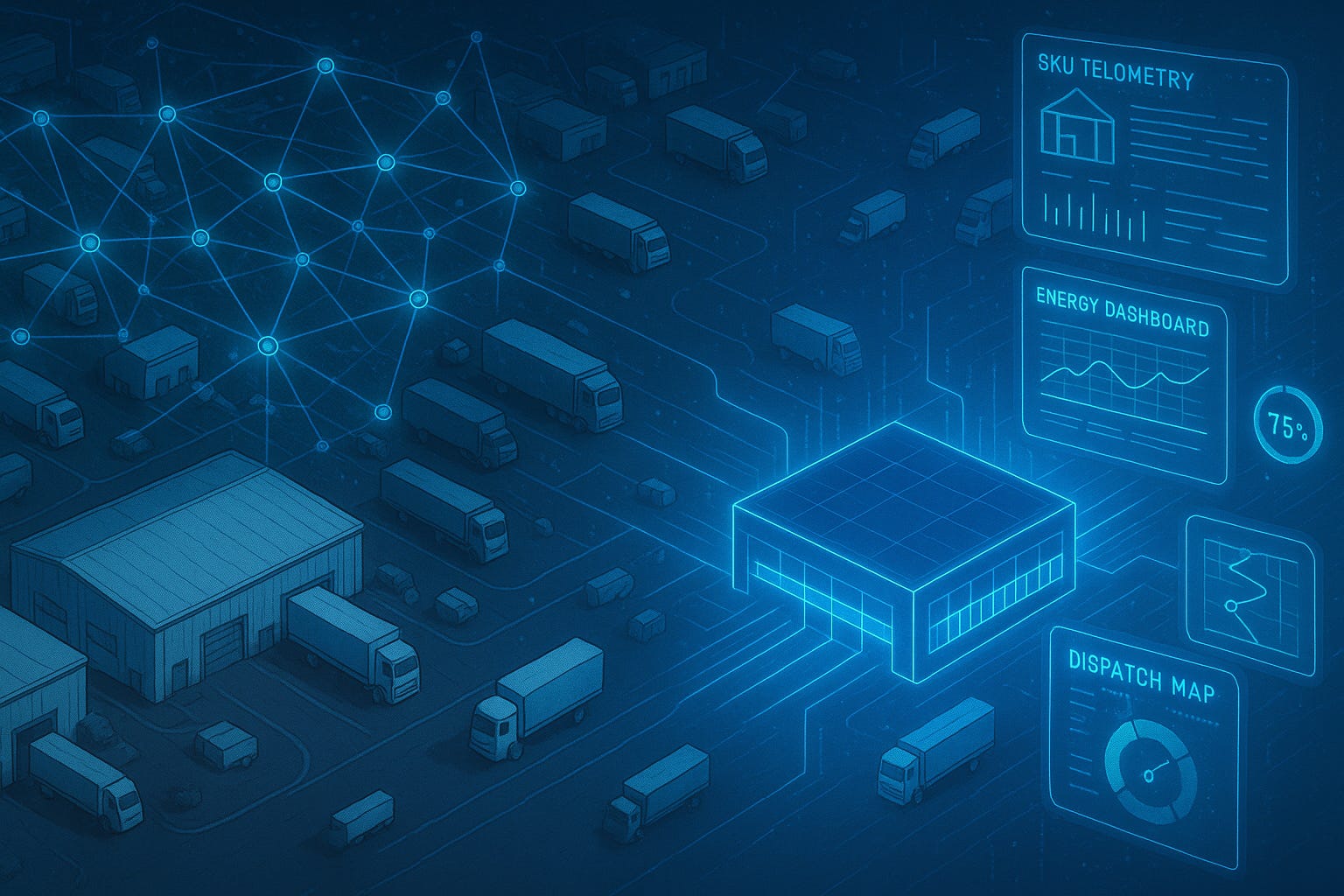
Lineage Link isn’t a dashboard, it’s infrastructure. It connects every facility, every single SKU, and transaction across its network, enabling predictive insights and operational automation at scale. From warehouse telemetry and energy optimization to live shipment tracking, this platform turns logistical chaos into structured and learnable data. This is the difference between just buying businesses vs. building a network. Every acquisition is integrated into a centralized intelligence layer, creating a network that doesn’t just grow, but into one that grows. This project had it’s roots laid in the pre-gen AI landscape where the data required to create accurate and usable models was much greater. With their foresight, which will pay them dividends moving forward, they have a literal mountain of trainable data against their competitors. Where most rollups centralize finance, Lineage centralizes insights. That’s what makes this machine compound.
The Blueprint: How to run an AI Roll-up
What worked in cold storage isn’t just unique to cold storage. It’s a playbook hiding in plain sight.
Choosing the Right Vertical: Where to start buying and building
The best industries for AI rollups aren’t sexy - they’re slow, messy, and often misunderstood. The most powerful AI Rollups are often in industries that aren’t already optimized. They’ll happen where their status quo is spreadsheets, not software. The ideal vertical make is fragmented, operationally intensive, and under digitized. The key differentiation is that there is data that exists but it’s scattered, siloed, or quite frankly ignored.
Think commercial HVAC, dental practices, freight forwarding. These are workflows rich with inefficiencies, where AI isn’t just something to please your LPs, it’s transformative. Oftentimes, they’re founder runs and cash flowing, these verticals offer predictive acquisition targets with room for standardization. Shoutout to Sahil Patwa at Unbound who compiled a list of industries that are prone to disruption. Feel free to check out this awesome piece of work at this link click to see.
Here’s the kicker, you don't need to build the model first. You need to own the data exhaust and that starts with controlling your workflow. That's why the best AI rollups don't just buy customers, they buy context.
Software First vs. Acquisition First
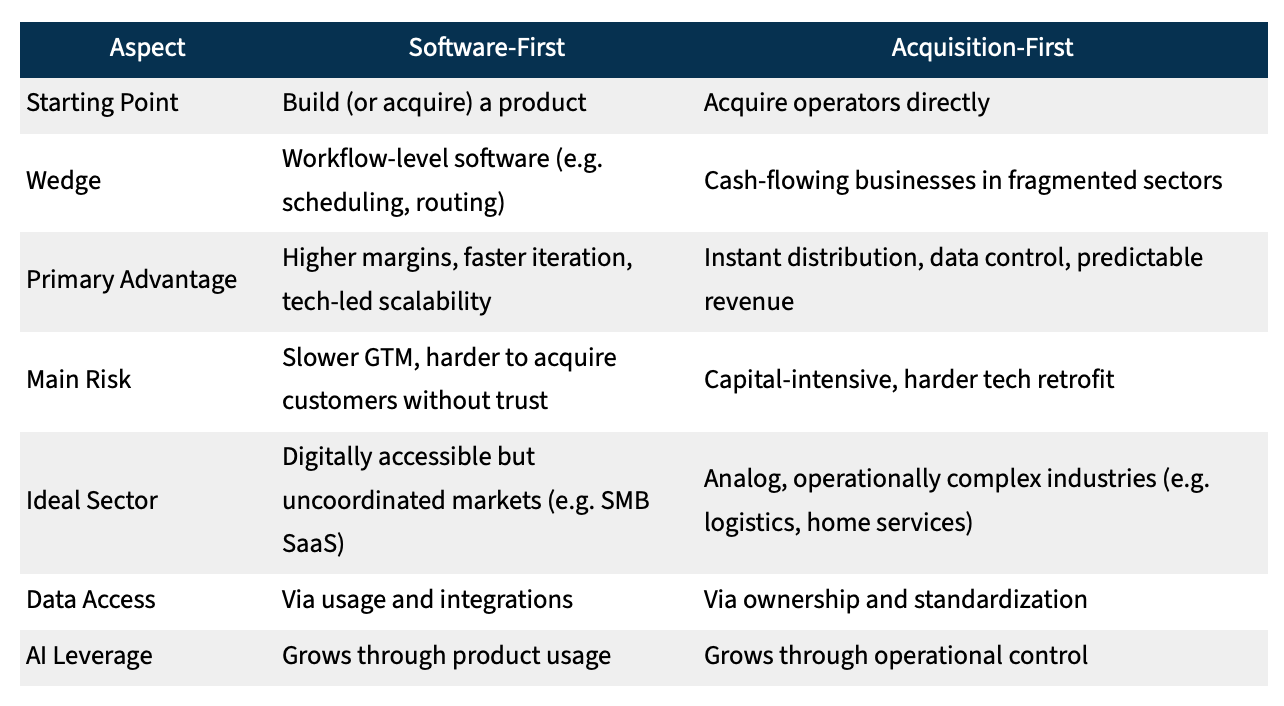
Before I start, shout out Evan Lynsang for this section, a majority of this will directly be referencing his work. There's no one path to building an AI rollup, but there are two dominant playbooks. Some start with a product and pull the market in. The other resounding playbook is with the market and pushing the product through. This choice between software first and acquisition first isn’t just tactical, it defines how value compounds from day one.
The software-first approach starts with building leverage before scaling. You begin with developing your software solution before acquiring or integrating with the operating business. Once you have landed with a wedge, you use that product to acquire operators, integrate their data, and build network effects from the inside out. This approach works best when your market is highly fragmented but digitally accessible, like dental EMR or freight forwarding services. With the right SaaS wedge, you don’t need to own the operator to control the workflow, you become the system that they will run on. Those are the positives, but the challenges are it’s slower to scale and harder to execute without deep vertical knowledge. But if this works? The software first model turns users into acquisition targets and your product into their infrastructure.
On the flip side, there's the acquisition first model. Instead of building product first, you acquire operators directly, often the traditional buy-and-build strategy, then layer in technology after the fact. The goal is to consolidate workflows, standardize data, and create the conditions for scalable AI deployment. This works best in sectors where software penetration is low, operational complexity is high, and businesses “insist” on running on excel and prayers (shoutout my external auditors). By owning the P&L from day one, you control the inputs being the process, data, and the incentives. That makes rollout faster and integration tighter, even if the product comes second. The tradeoff being this is insanely capital intensive. If well executed, this model will give you immediate distribution, predictable cashflows, and raw inputs needed to train powerful vertical specific AI systems. You don’t just digitize the industry, you own it before you optimize it.
Implications for Investors: A new mandate for private capital
What began as an M&A strategy is quickly becoming a portfolio wide shift. GPs are no longer just studying rollups for quick scale, they’re treating them as systems for compounding operational advantage. The Lineage model is turning heads, not because it’s loud, but because it’s working and quite well. In 2024, they were named the largest IPO of the year, raising $4.4 billion at the bell. Repeatable M&A, embedded AI, and high integrity infrastructure? That’s not just a playbook, that’s a platform strategy.
The simple reason. AI rollups behave like digital infrastructure. They take industries that were previously offline and turn them into intelligent and integrated systems. The result isn’t just margin expansion. It’s network control. In this mode, owning the workflow means owning the market and the infrastructure layer becomes the new power base. Lineage is a proof of concept. It didn't just win in logistics, it validated a new type of investment, turning complexity into defensibility. Going forward, the firm that leans in early won’t just better exit at a pretty multiple, they will dictate the market. In a market that is starved for durable alpha, this isn't just a side bet. It’s the new mandate.
The firms that dominate the next decade won’t be those with the most assets, but those with the smartest ones.
Editors & Contributors:
Evan Lyseng - AltaML
Mayako Kruger - AltaML
Sahil Patwa - Unbound
Suraj Sivaraja - University of Waterloo / Waterloo Venture Group
Jess Purba - University of Waterloo
Hitanshi Patel - University of Waterloo